
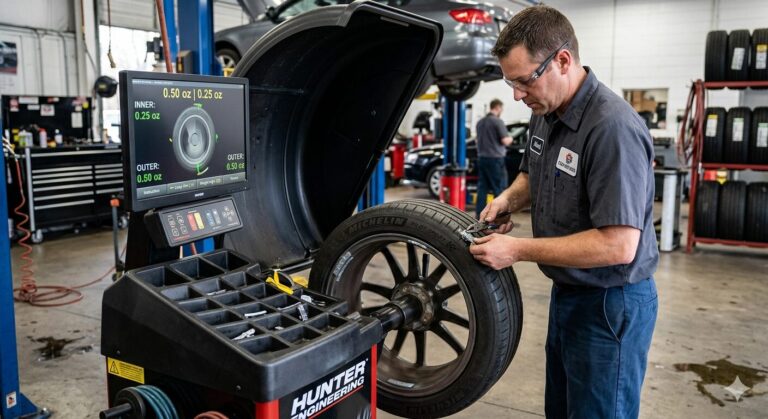
If your car vibrates at high speed or your tires wear unevenly, chances are your wheels are out of balance. Learning how to balance tires is essential for maintaining a smooth ride, improving safety, and extending tire life.
In this complete guide, you’ll learn everything—from basic concepts to step-by-step instructions, costs, tools, and expert tips.
What is Tire Balancing?
Tire balancing is the process of correcting uneven weight distribution in a tire and wheel assembly. Even a small imbalance can cause vibrations when driving at higher speeds.
During balancing, small weights are added to the rim to ensure the tire rotates evenly.
How Tire Imbalance Happens
Tires become unbalanced due to several reasons:
- Manufacturing imperfections
- Uneven tread wear
- Hitting potholes or bumps
- Improper tire installation
- Loss of wheel weights over time
Even brand-new tires often require balancing.
Why Tire Balancing is Important
Tire balancing plays a critical role in vehicle performance and safety.
First, it ensures a smooth driving experience by eliminating vibrations. Second, it helps save money by preventing uneven tire wear and extending the lifespan of your tires. Third, it improves fuel efficiency by reducing rolling resistance. Finally, it protects important components such as the suspension and steering system from unnecessary stress.
Signs Your Tires Need Balancing
There are several warning signs that indicate your tires may be unbalanced:
- Steering wheel vibration at speeds between 60–100 km/h
- Uneven or patchy tire wear
- Car shaking or vibrating at higher speeds
- Unusual road noise or humming sounds
- Reduced overall driving comfort
Ignoring these signs can lead to more serious mechanical issues.
How to Balance Tires (Step-by-Step Guide)
Step 1: Lift the Vehicle
Use a jack to lift your car safely and secure it with jack stands.
Step 2: Remove the Tire
Loosen the lug nuts and carefully remove the wheel from the vehicle.
Step 3: Mount on Balancing Machine
Place the wheel onto a tire balancing machine. The machine will spin the wheel to detect any imbalance.
Step 4: Identify Imbalance
The machine will indicate the heavy and light spots on the tire.
Step 5: Add Wheel Weights
Attach small metal or adhesive weights to the rim to balance the tire.
Step 6: Recheck Balance
Spin the wheel again to confirm that it is properly balanced.
Step 7: Reinstall the Wheel
Put the wheel back onto the car and tighten the lug nuts securely.
Tools Required for Tire Balancing
To balance tires yourself, you will need the following tools:
- Tire balancing machine or manual balancer
- Wheel weights
- Car jack and jack stands
- Lug wrench
- Torque wrench
Without the right tools, achieving accurate results can be difficult.
Types of Tire Balancing
There are three main types of tire balancing:
Static balancing focuses on correcting vertical imbalance.
Dynamic balancing corrects both vertical and side-to-side imbalance and is the most commonly used method.
Road force balancing is an advanced method that simulates real driving conditions for maximum accuracy.
DIY Tire Balancing vs Professional Service
DIY tire balancing can save money but requires tools and experience. It may not always provide accurate results.
Professional tire balancing is more precise, faster, and does not require any equipment on your part. For most drivers, professional service is the better option.
Cost of Tire Balancing
The cost of tire balancing depends on your location and service provider.
In Pakistan, it typically ranges from PKR 500 to 1500 per tire.
In the United States, it usually costs between $10 and $25 per tire.
Advanced balancing services may cost more.
Also Read: How Long Does It Takes to Change Tire
How Often Should You Balance Tires?
You should balance your tires regularly to maintain optimal performance.
It is generally recommended every 5,000 to 10,000 kilometers, when installing new tires, after hitting a pothole, or whenever you feel vibrations while driving.
Tire Balancing vs Wheel Alignment
Tire balancing and wheel alignment are often confused but serve different purposes.
Tire balancing corrects uneven weight distribution and eliminates vibrations.
Wheel alignment adjusts the angles of the wheels to ensure proper steering and handling.
Both are important for overall vehicle performance.
Common Tire Balancing Mistakes
Avoid these common mistakes:
- Ignoring minor vibrations
- Incorrect placement of wheel weights
- Skipping the recheck process
- Not balancing all four tires
- Using low-quality weights
These mistakes can reduce the effectiveness of tire balancing.
Expert Tips for Perfect Tire Balance
For best results, follow these tips:
Always balance new tires after installation.
Check wheel weights regularly to ensure they are intact.
Rotate your tires every 8,000 kilometers.
Avoid driving on rough roads or potholes when possible.
Use professional services for accurate balancing.
Frequently Asked Questions
Can I drive with unbalanced tires?
Yes, but it can lead to uneven tire wear and damage to suspension components over time.
How long does tire balancing take?
It usually takes about 20 to 30 minutes for all four tires.
Do new tires need balancing?
Yes, all new tires require balancing.
Is tire balancing necessary after tire rotation?
Yes, balancing is recommended after rotation for optimal performance.
Conclusion
Understanding how to balance tires is essential for maintaining a safe and comfortable driving experience. Regular tire balancing reduces vibrations, extends tire life, and protects your vehicle from unnecessary wear and tear.
Whether you choose to do it yourself or rely on a professional, keeping your tires properly balanced will save you money and improve overall performance.
